Your Postpartum Door Policy: Word-for-Word Scripts for Visitors Who Don't Take Hints
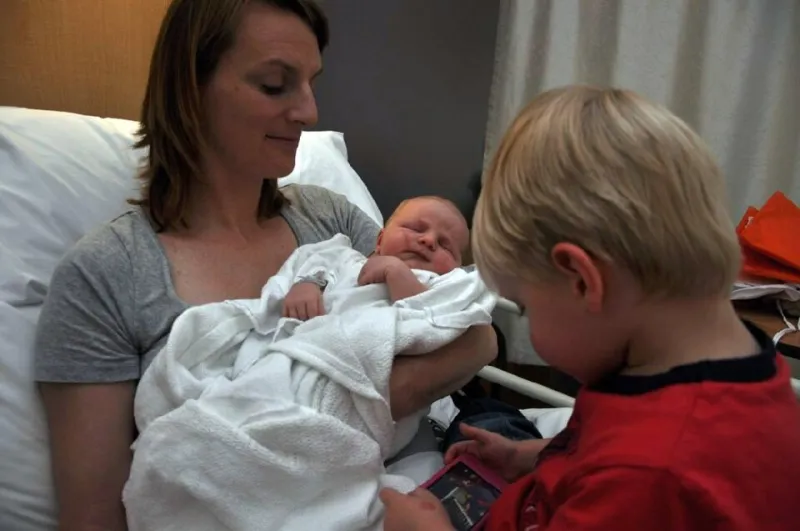
Photo: Tom Reynolds from Melbourne, Australia, CC BY 2.0, via Wikimedia Commons
Boundaries are not a personality flaw. They are a postpartum medical supply. In the first weeks after birth, you are healing, bleeding, feeding, sweating, crying, and sleeping in fragments. Visitors can wait. Your job is not to host a meet-and-greet. Your job is to recover and keep a tiny human alive.
Build your hierarchy before you need it
Not every boundary is equally urgent. Start with Tier 1: health and safety. No sick visitors. Handwashing before holding the baby. No kissing the newborn. Vaccines as recommended by your pediatrician. No smoking around the baby. These are not flexible.
Tier 2 is rest and bonding: limited visits, short visits, scheduled visits, no drop-ins, and visitors leaving when you ask. Tier 3 is logistics: who drops off food, walks the dog, or does dishes. Tier 4 is preferences: photos, holding the baby, advice. Be flexible on Tier 4 so you can hold the line on Tier 1.
Hospital scripts
If you want no visitors, say it before you are admitted: 'We are keeping hospital visits to just us while I recover. We will send photos and let you know when we are ready at home.'
If someone shows up anyway, you do not have to entertain them. Ask your nurse to run interference: 'Can you tell them we are not accepting visitors right now?' That is what nurses are for.
If you are up for a short visit but not a long one: 'Thanks for coming. I need to feed and rest now, so we are going to wrap up.' No apology spiral required.
Home visit scripts
Pick a start date, even if it is vague: 'We are not scheduling visits until next week. After that, we would love to see you. We will text when we are ready.'
For drop-ins: 'We are in survival mode and not doing drop-ins. I will let you know when we are up for a visit.'
For people who overstay: 'I need to feed and rest now. Thanks for coming.' You can say it while standing up. You can say it while holding the door. You can say it twice.
For the relative who says 'I am just stopping by': 'I appreciate the thought, but we are not taking visitors today.'
Illness rules without a debate
Use one clear sentence: 'If you or anyone in your house has a fever, cough, vomiting, diarrhea, or a positive test, please visit another time. No hard feelings, we are just protecting the baby.'
For handwashing and kissing: 'We are asking everyone to wash hands before holding the baby and skip kissing the face. Pediatrician's orders.' If someone argues, repeat the same sentence. You are not running for office. You do not need to win the debate.
Grandparents who think rules are suggestions
Grandparents are often wonderful and also deeply convinced that rules are for other people. Do not overexplain. Offer a job instead: 'The best help right now is dropping off food, walking the dog, or doing dishes. Baby snuggles come later.'
If they push: 'We know you are excited. The rule is handwashing and no kissing. If that does not work for you, we can try again next week.'
For unsolicited advice: 'Thanks, we will ask the pediatrician.' Then change the subject. You do not have to defend every choice.
Let your partner own their side
Agree before birth that each person handles their own family. Your partner does not get to be the nice one while you play bad cop. Their script can be simple: 'We are following our pediatrician's guidance, and we are not debating it.' Or: 'We are not having visitors this week. I will let you know when that changes.' Or: 'Please do not ask [parent] again. Ask me.'
If your partner caves under pressure, say it plainly: 'I need you to be the bad guy with your family so I can heal.' That is not harsh. That is teamwork.
Guilt is not a medical requirement
You do not need a medical excuse to say no. You do not need to make your house look nice. You do not need to pass the baby around like a party platter. A short text is enough. The same script works on repeat. Thank people, redirect them, and protect your rest.
If you are feeling anxious, panicked, or hopeless, tell your OB or midwife. Boundaries help, but postpartum mental health support matters too.